queetcy/about
A custom portal for how you work, develop and play

A tailor, not a department store.

The beauty of AI is that you can create custom solutions that meet your specific needs and change with you. Instead of buying a new outfit for the upcoming event, you have a personal tailor who can very quickly make your favourite tuxedo or little black dress fit you perfectly, even though you've put on a few pounds, and just as easily take it in when you finally get around to losing the weight.

Queetcy is that tailor.

One door

"I don't open Claude.ai, the Claude app or ChatGPT day to day anymore. Queetcy is the one portal where I do all of my work. It's the same Claude and ChatGPT, plus my own private AI, in one place that already knows my house, my calendar and my mail."
What it is

Seven rooms, one house.

Console

The house, on demand.

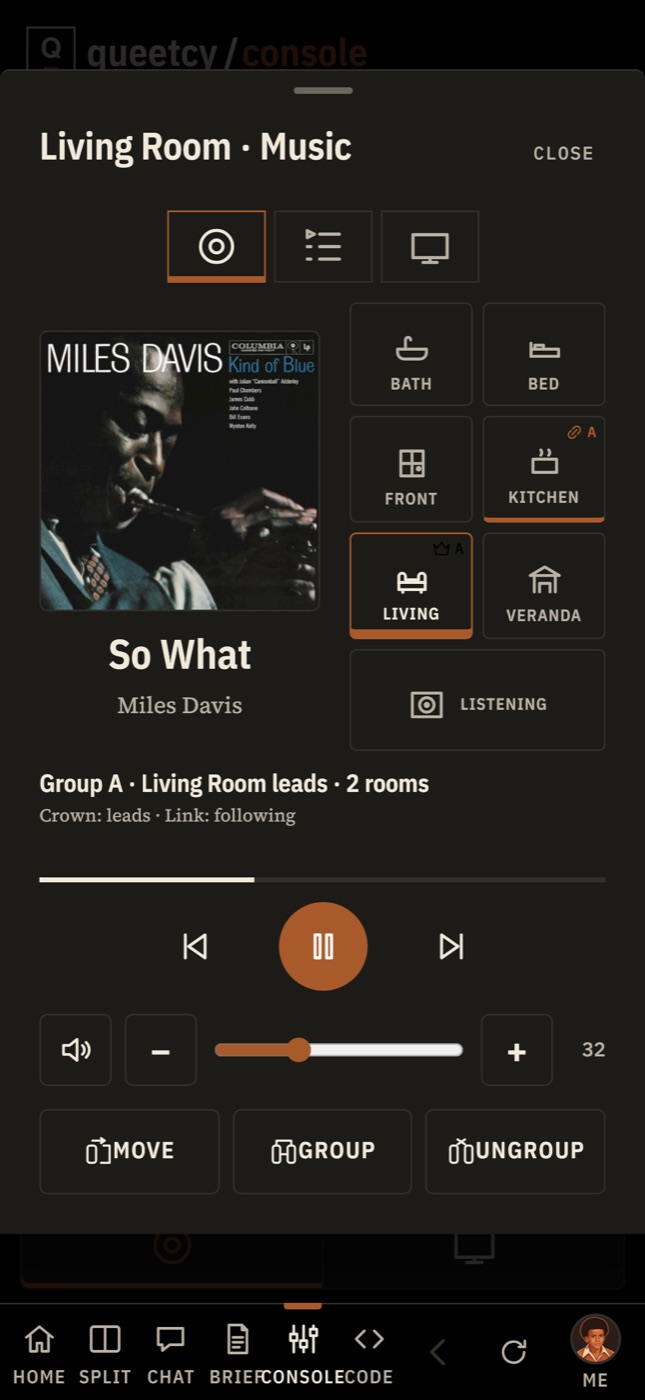
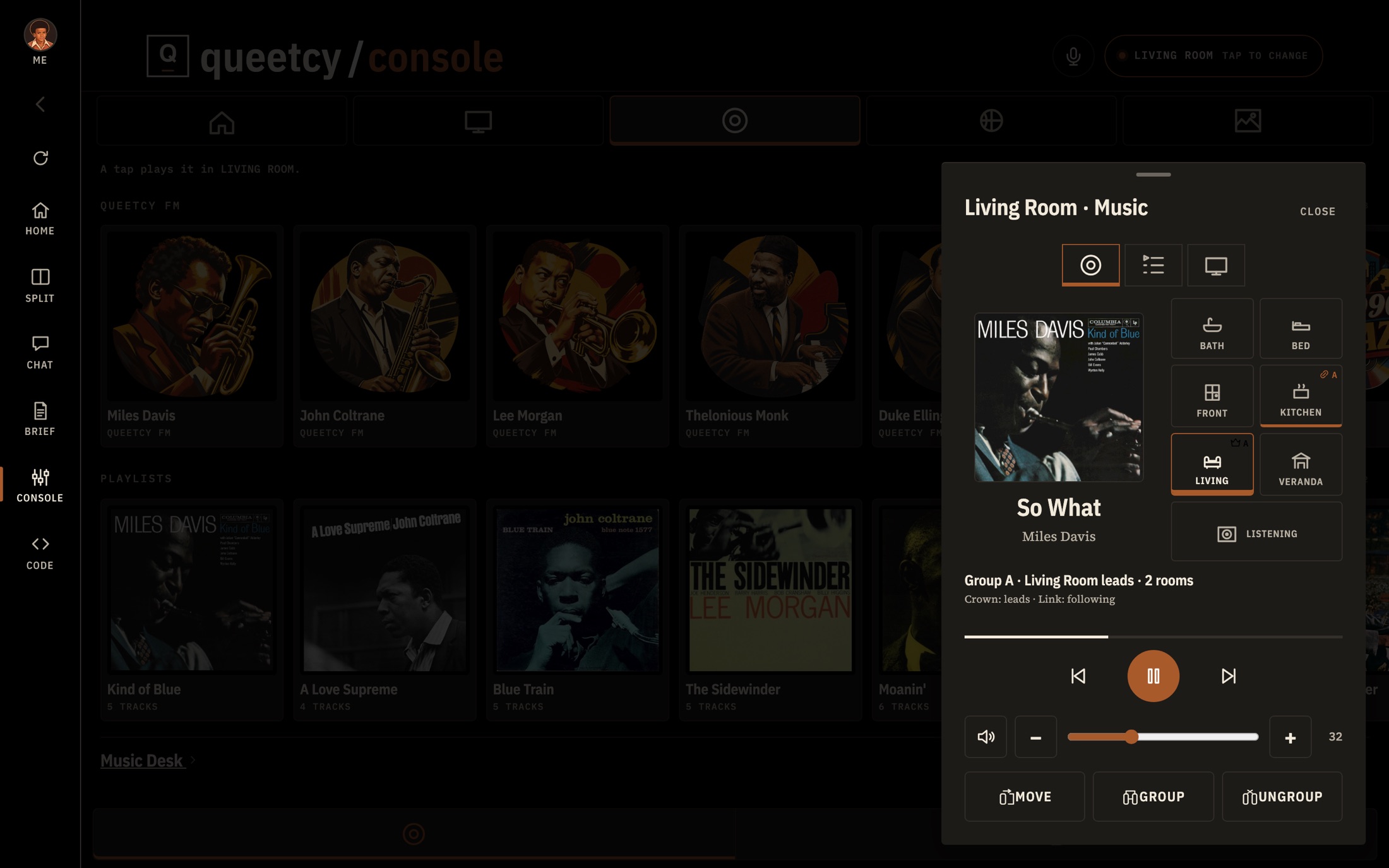
Console controls every speaker in the house, along with the TVs, the lights and the art on the walls.

  • "Play Kind of Blue in the living room." The original take, in hi-res, in that room only.
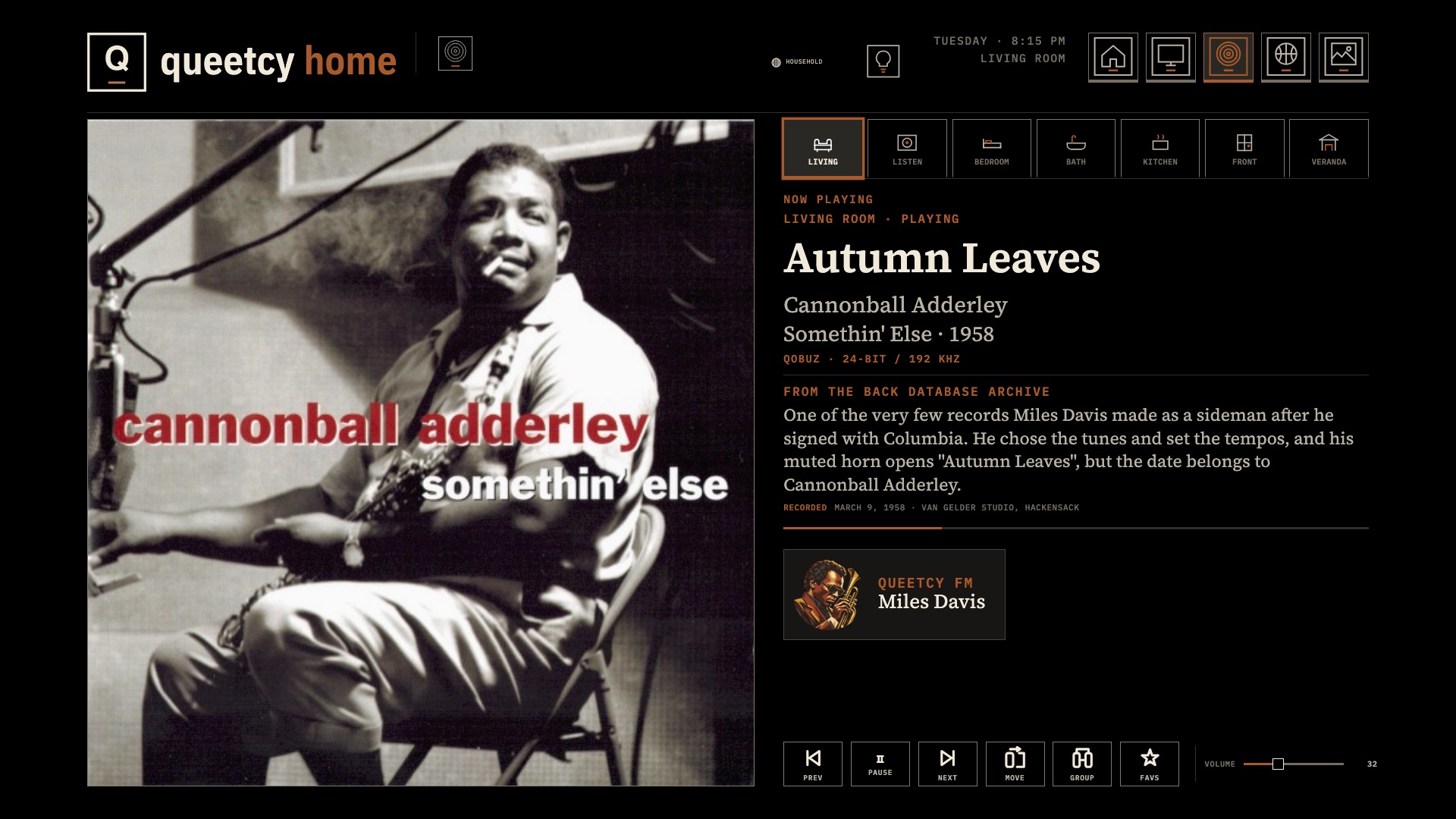
  • Tune in to Queetcy FM, your own personalized radio station, with a DJ who drops a little trivia between songs. Even stations on demand: "a Miles Davis station", "Blue Note in the '60s", "Sunday morning gospel", "my high school years".
  • Move the music from the kitchen to the bedroom without it skipping a beat, or group rooms so the whole house plays one record.
  • Put the game on the TV, find the episode where "that thing happened", or pick up a show where you left off.
  • Dim the lights or turn up the heat.

Or skip the buttons and just say it. Talk to Queetcy and it plays, finds, dims or answers.

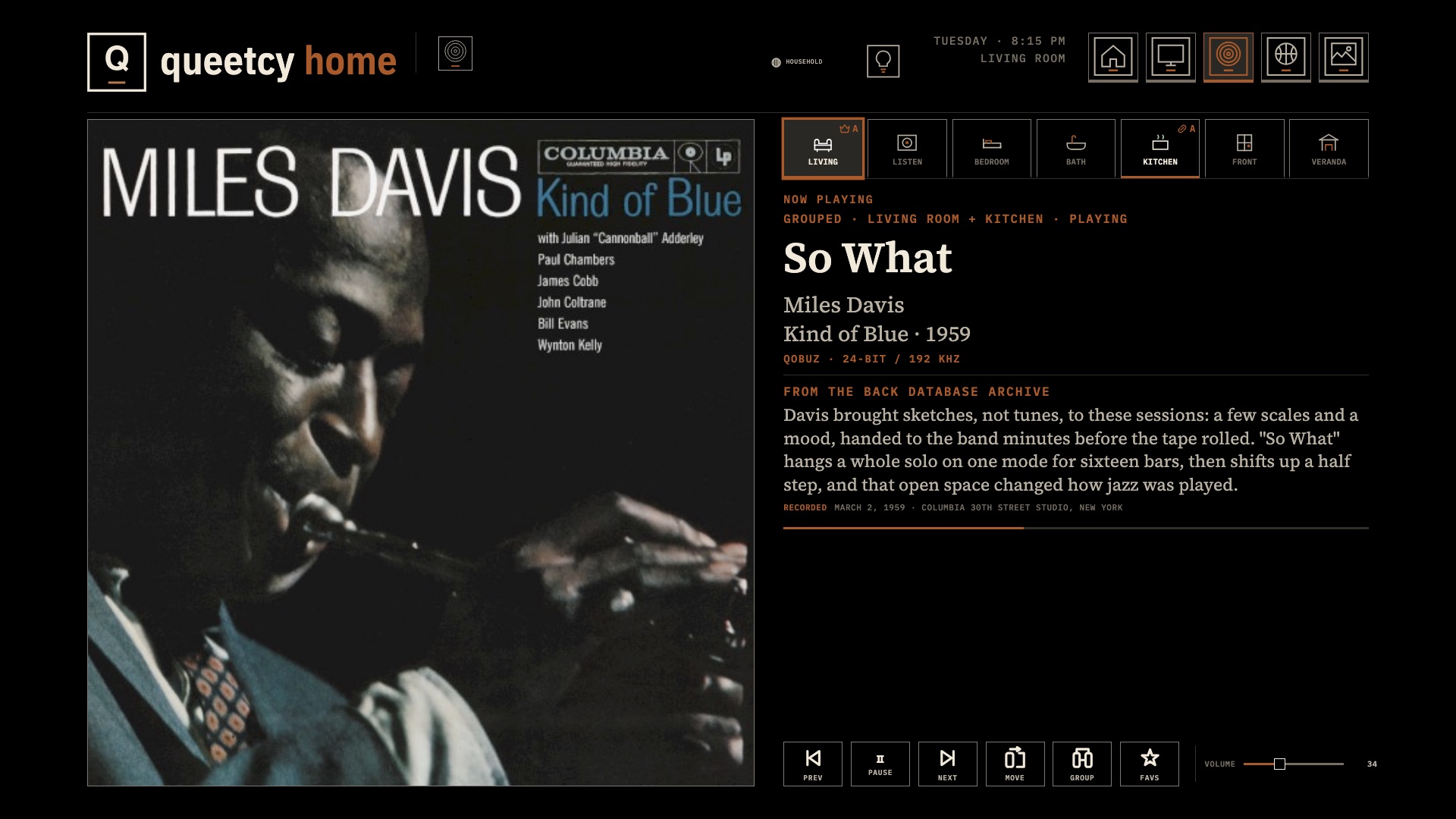
Console: Living Room playing Kind of Blue, grouped with the Kitchen
TV

The big screen is a Queetcy screen too.

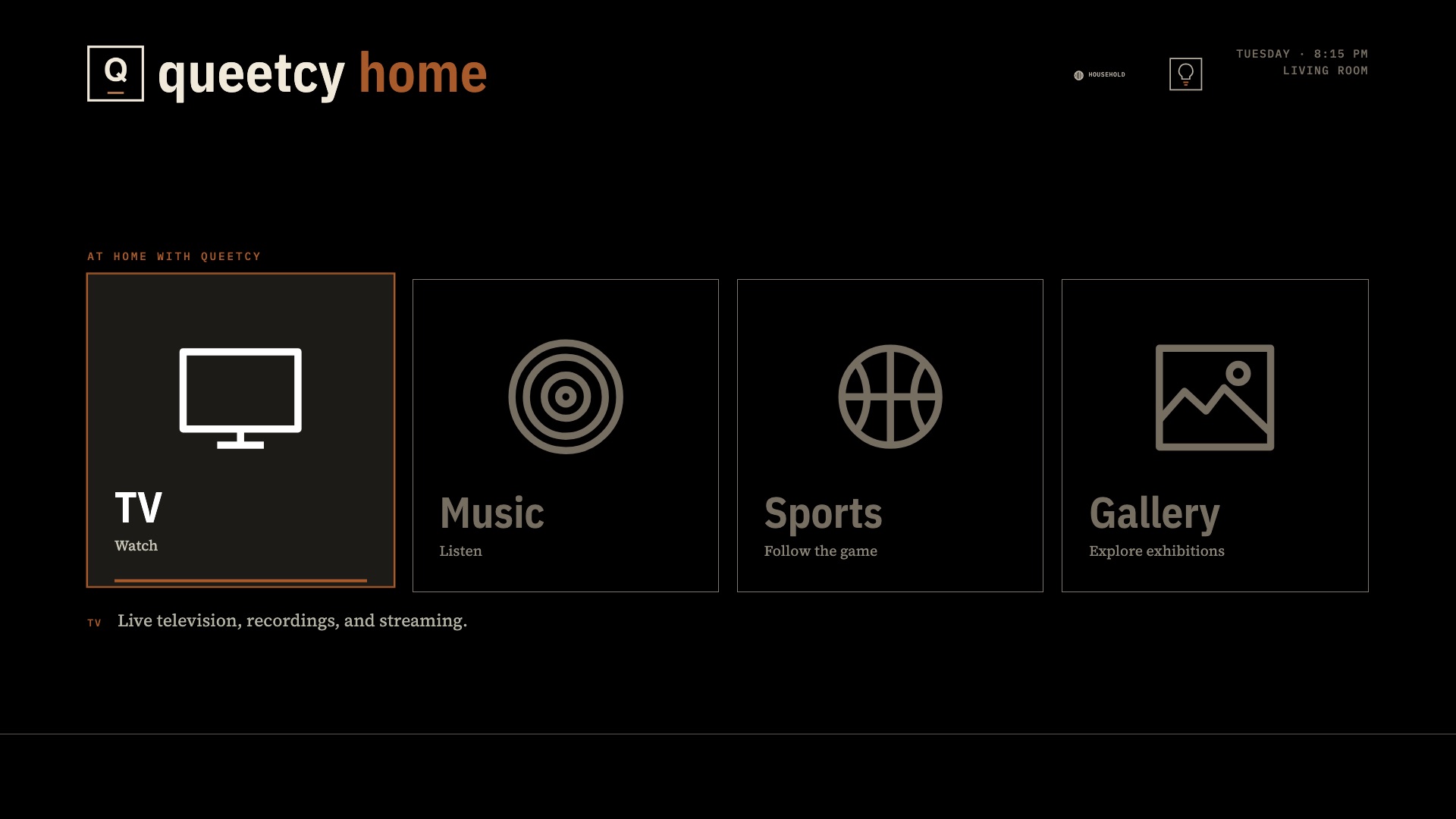
Every TV in the house runs Queetcy's own home screen, so the TV and the apps are two doors into the same house.

  • The apps run the TVs. From your phone, put the game on in the living room, pick up a show where you left off, or put an exhibition on the Frame. No hunting for the right remote or the right app.
  • The TVs do what the apps do. From the couch, with the remote, play music in any room, start a Queetcy FM station, or group the kitchen with the living room. The TV isn't just something you watch; it's another console.
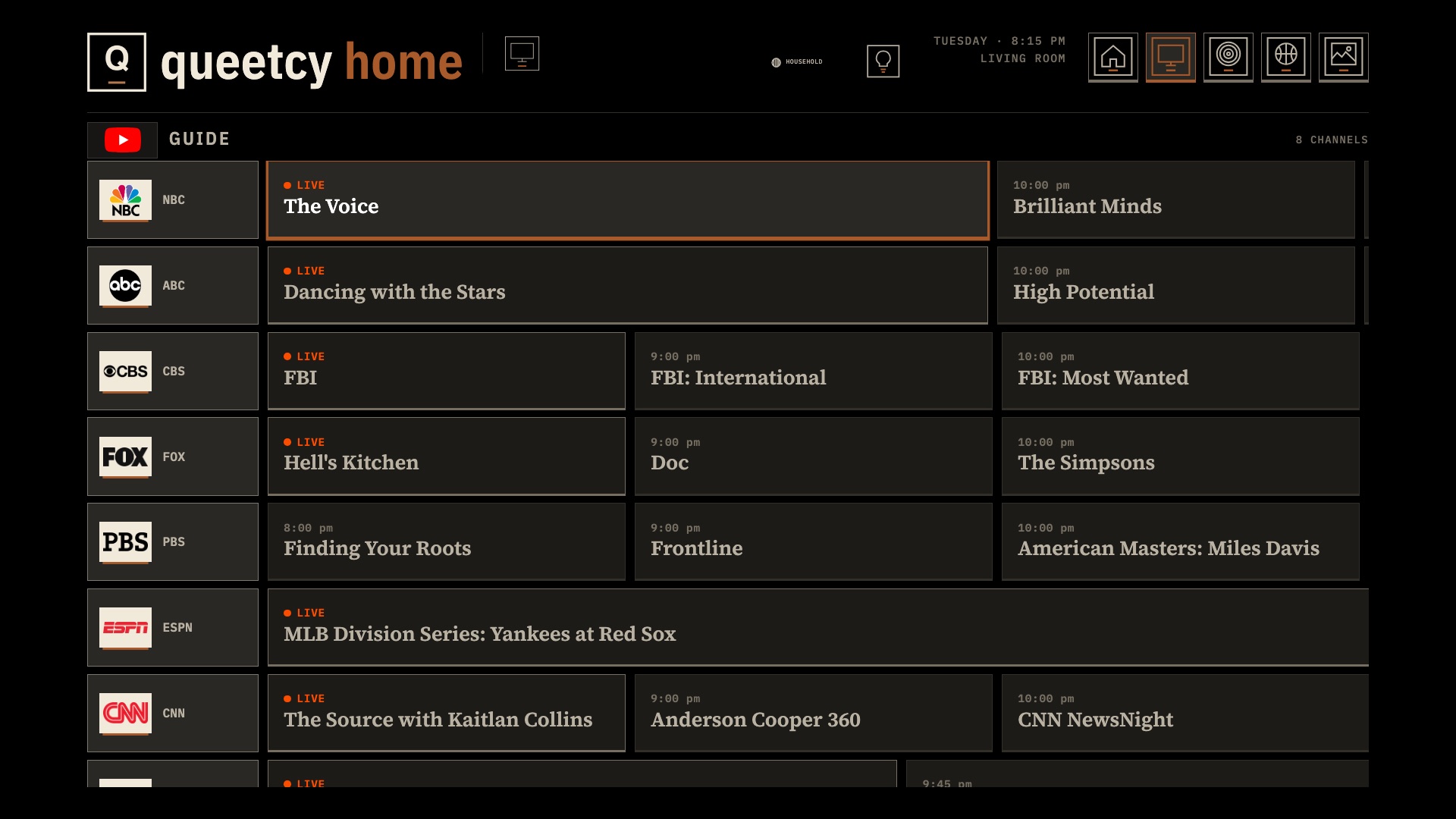
  • Live TV that actually tunes. The guide goes straight to the channel, not to an app's front page where you start hunting again.
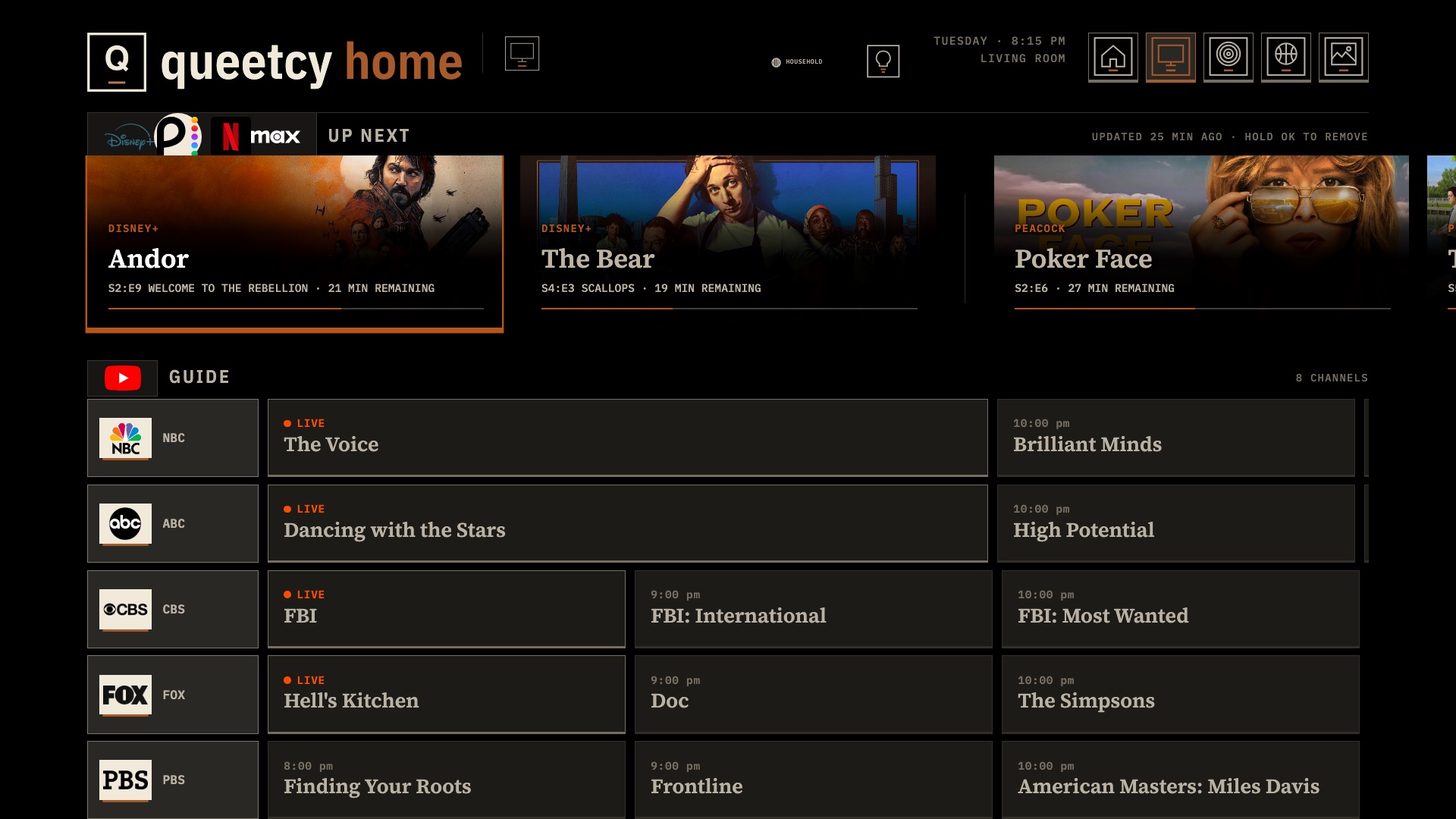
  • One Up Next shelf. Whatever you're halfway through, on Disney+, Netflix, Max or Peacock, sits in one row.
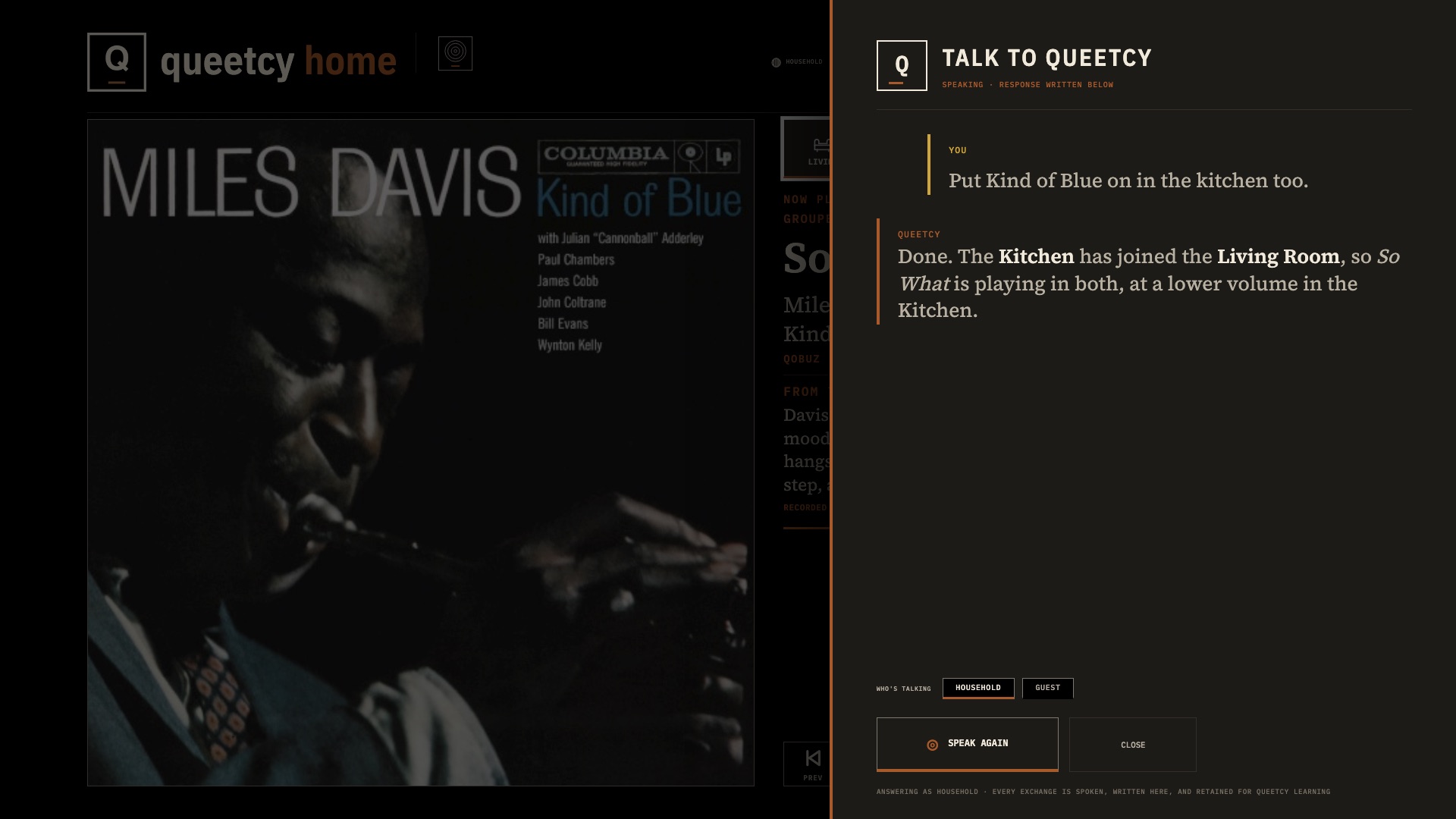
  • Just ask. "Put Kind of Blue on in the kitchen too." Queetcy answers on screen and does it.
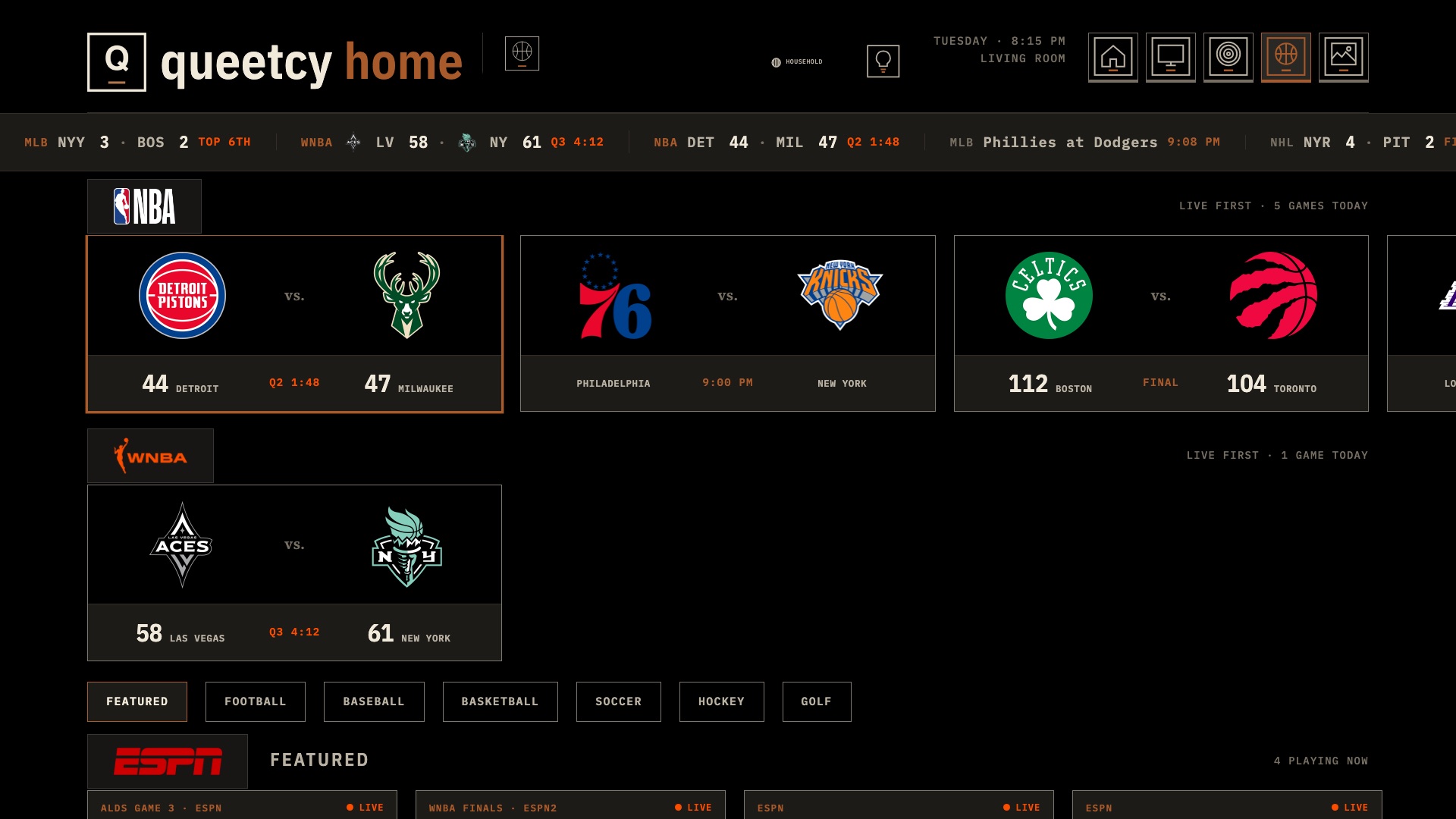
Four doors, one remote: watch, listen, follow the game, or walk through an exhibition.
Up Next puts the shows you're halfway through, from every streaming app, on one shelf.
Live TV with a real guide: what's on now, what's next, and one press to tune.
The TV runs the music in every room; here the Kitchen has joined the Living Room for Kind of Blue.
Queetcy FM builds a station around an artist and tells you the story of each record as it plays.
Tonight's games, live scores and where to watch, in one place.
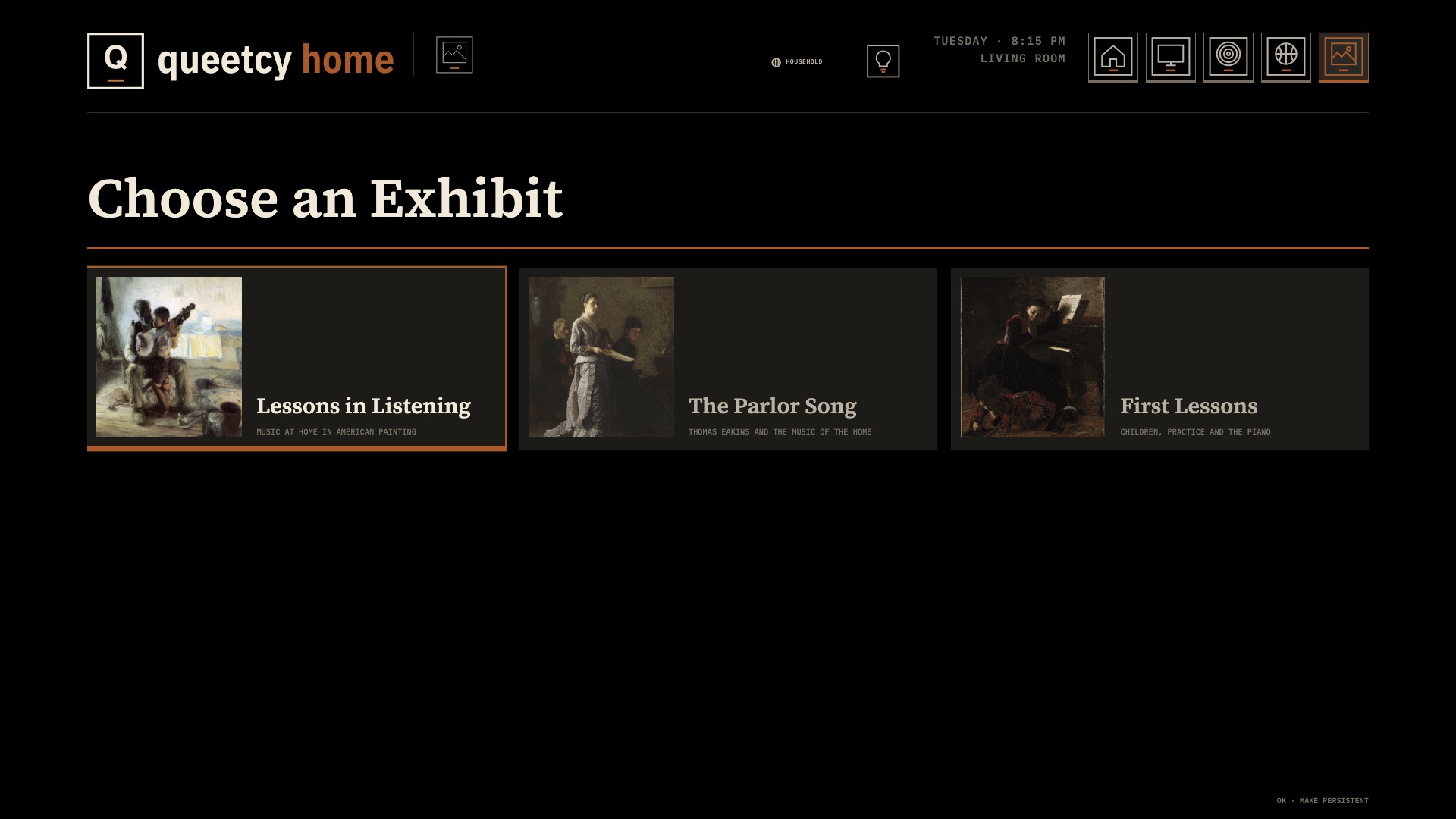
Turn the TV into a gallery: pick an exhibition and it stays on the wall.
Just ask: Queetcy answers on screen and does it.
TV · Art

A museum in the house.With a docent who knows every piece.

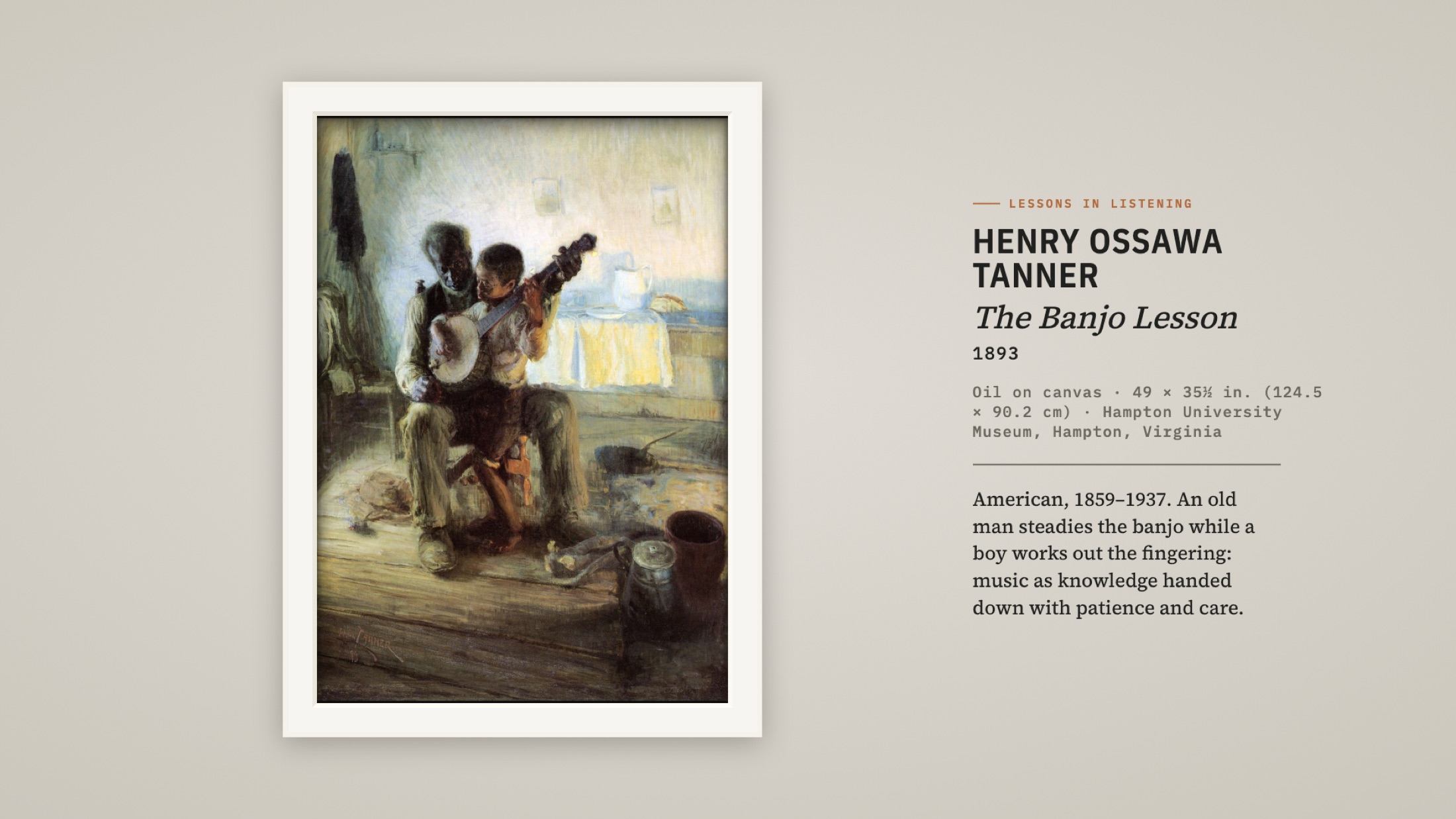
Queetcy stages museum-level exhibitions on the Frame TVs around the house, and it is a docent for the collection: ask about any piece and it tells you the story behind it. From the current show, Lessons in Listening:

Henry Ossawa TannerAmerican, 1859–1937
The Banjo Lesson, 1893
Oil on canvas · 49 × 35½ in. (124.5 × 90.2 cm)
Hampton University Museum, Hampton, Virginia

Tanner painted The Banjo Lesson in 1893, on a long visit home from Paris, and showed it at the Paris Salon the next spring. By then the banjo had become the stock prop of minstrel caricature. Tanner takes it back. An old man steadies the instrument while a boy, settled in his lap, works out the fingering. Look at how the light gathers on the two of them and leaves the bare room in shadow: nothing here is performed for an audience. Music is shown as knowledge handed down with patience and care, and the painting remains a landmark for the dignified depiction of Black life in American art.

The Banjo Lesson on a Frame TV with its museum label
Business

The to-do list that helps you get sh*t done.

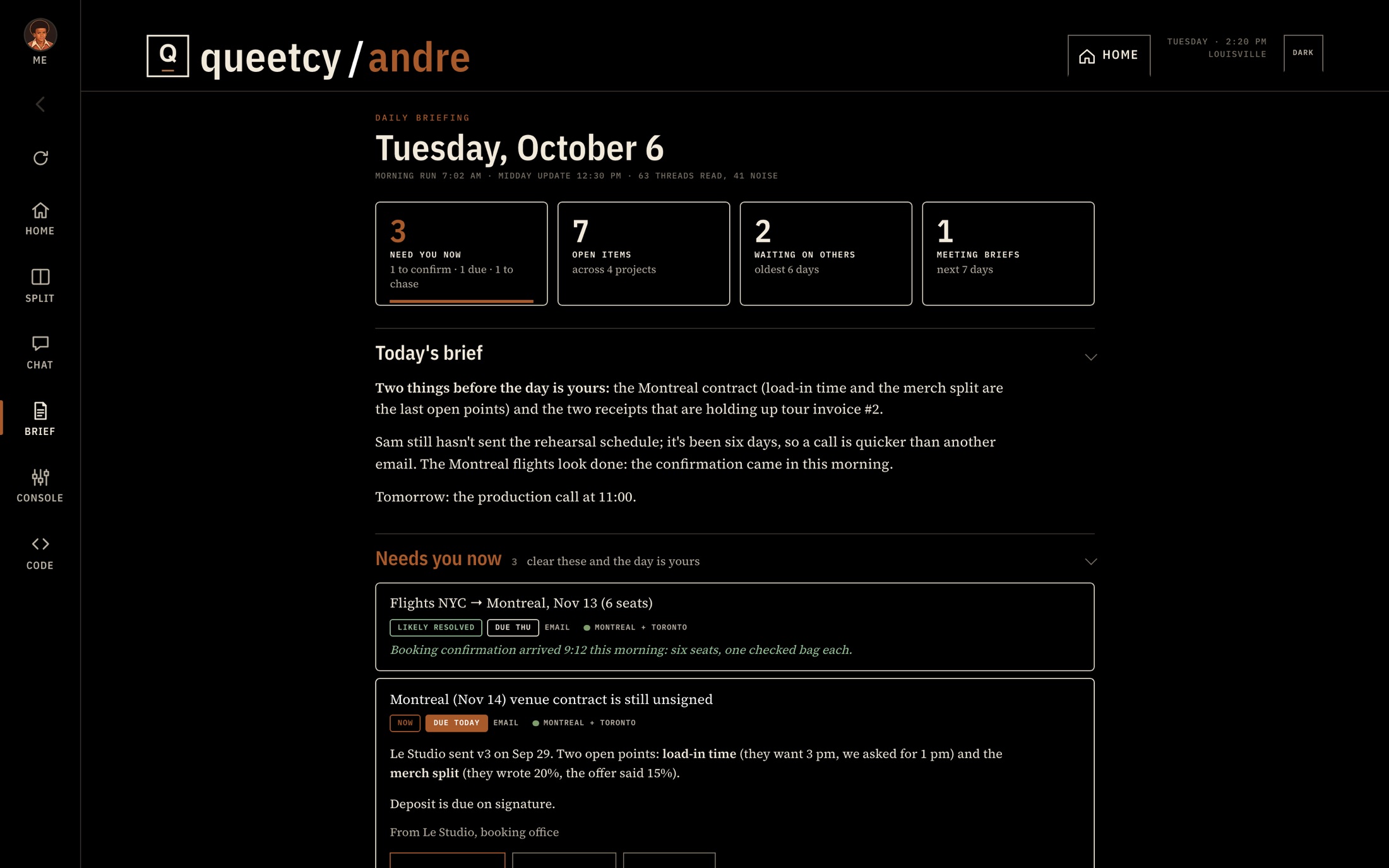
The hardest part of a to-do list isn't doing the things. It's working out what actually needs doing. Every morning Business gets all up in your business, but privately. It reads your mail, calendar, messages and documents and writes the Daily Brief: what's due, what's slipping, who's waiting on you, and what can wait. Things you've already handled drop off the list without being told.

Then it helps you do the work. Every item has helpers at your fingertips: Claude, ChatGPT, and your own private AI running at home. They draft the reply, pull up the contract, chase down the receipt or build the invoice. Then they hand it back for you to send, because nothing ever goes out without your approval.

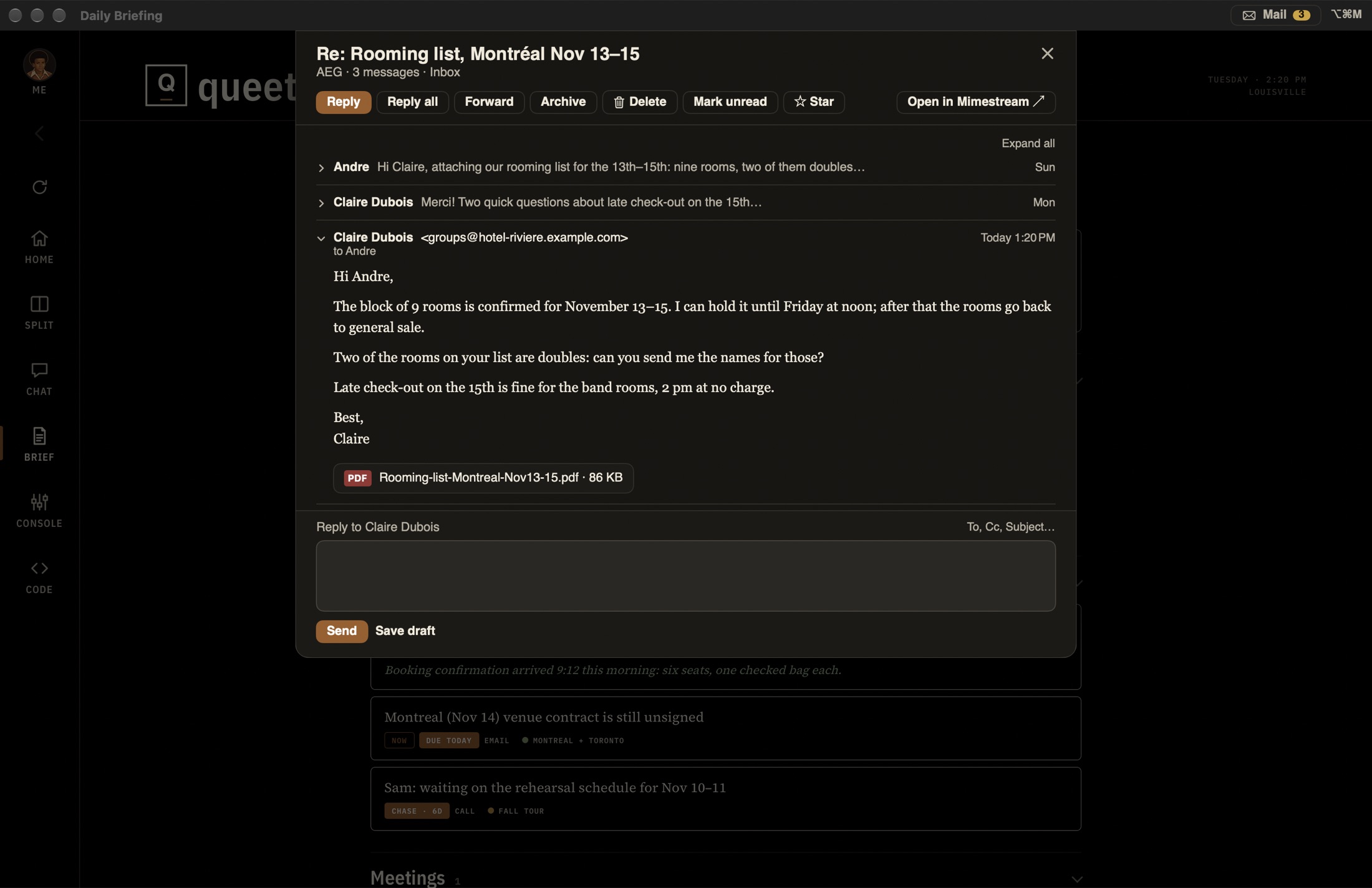
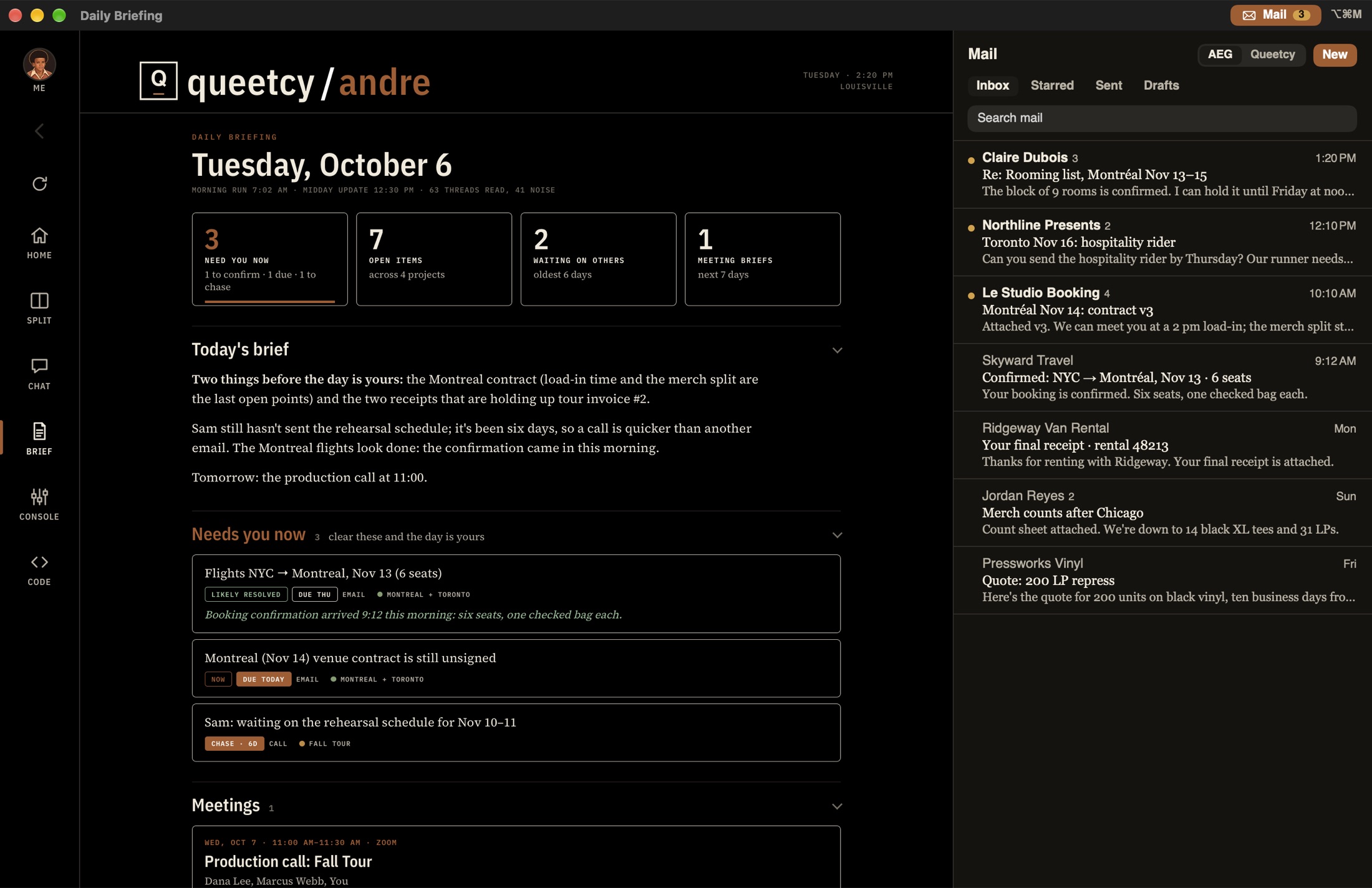
Mail opens where mail lives. When the Brief says a draft needs a look or a thread needs checking, one tap opens it in Mimestream, the Mac app for Gmail, in its own window. No hunting through browser tabs.

No rogue agents here.

The Daily Brief
Chat

Your AI, on your terms.

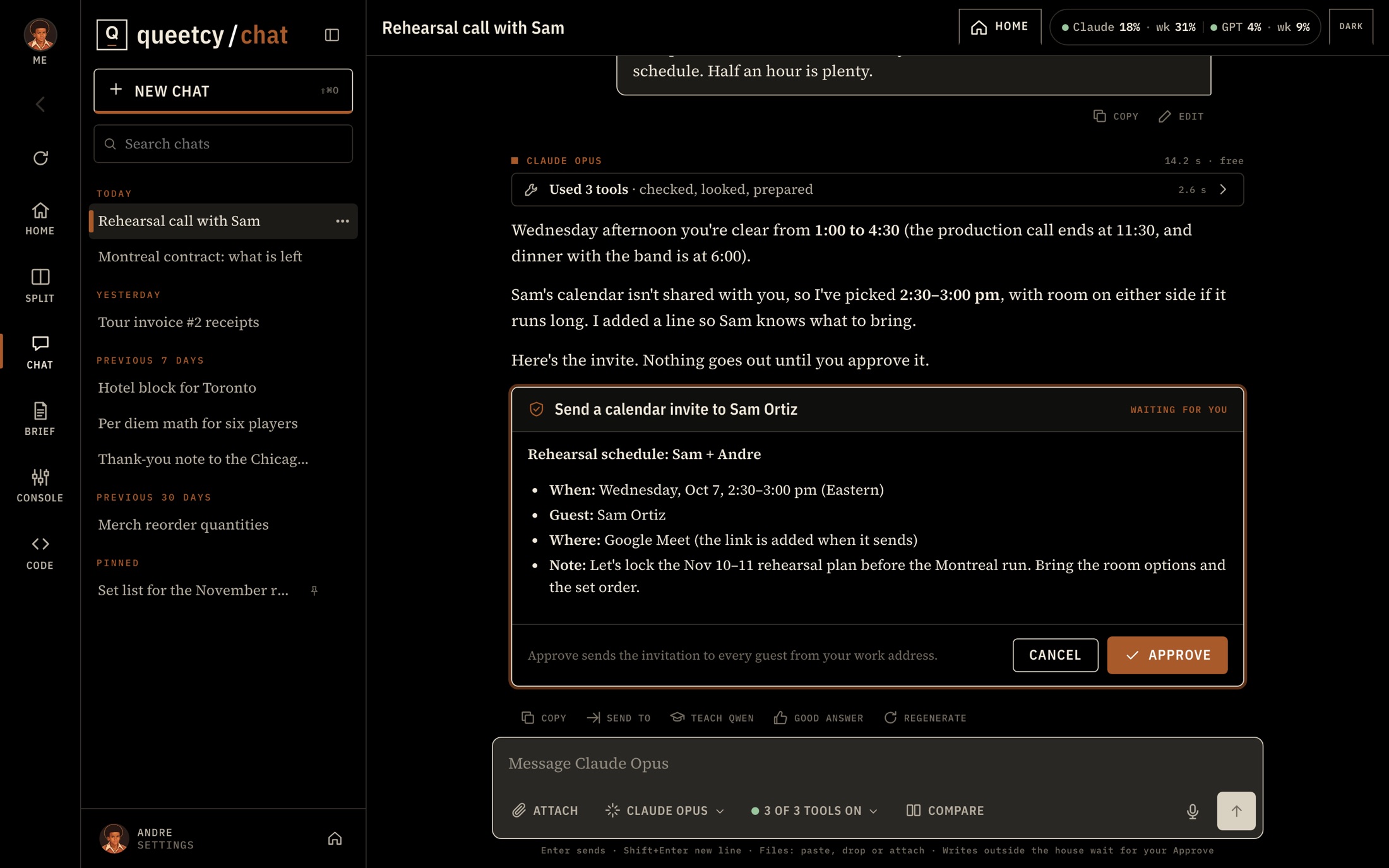
Speaking of private AI: Chat is a private place to talk to all of your models at once. That means the subscriptions you already pay for, models you pay for by the question, and an AI that runs on your own machine and never leaves the house. Pick one, or ask two the same question and compare their answers.

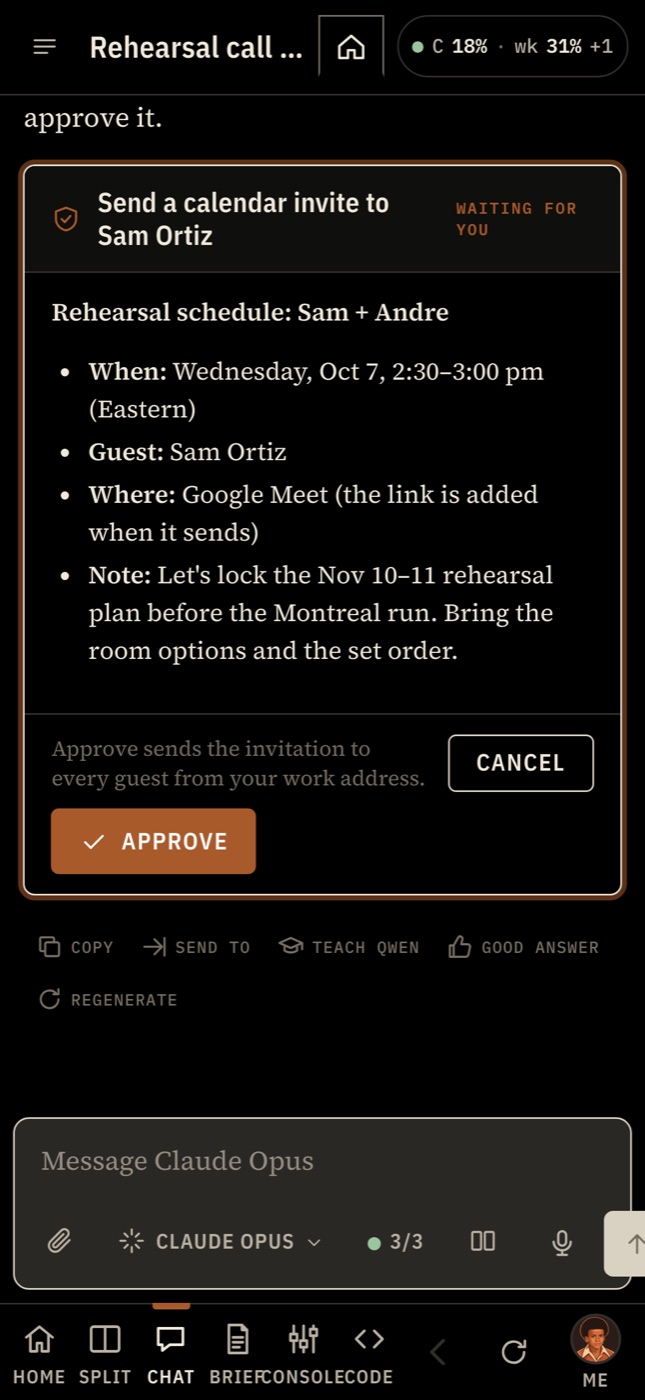
Chat already knows your calendar, your mail and your projects, so you never have to paste in context. Anything that matters (an email, an invite, a payment) waits for your Approve.

Chat with an Approve card for a calendar invite
Code

Dream, design and do.That's the order of coding, and Code follows it.

  • Dream. You describe what you want in plain English. You don't need to be a programmer.
  • Design. Claude, the senior engineer, works out how it should be built and talks it through with you before anything changes.
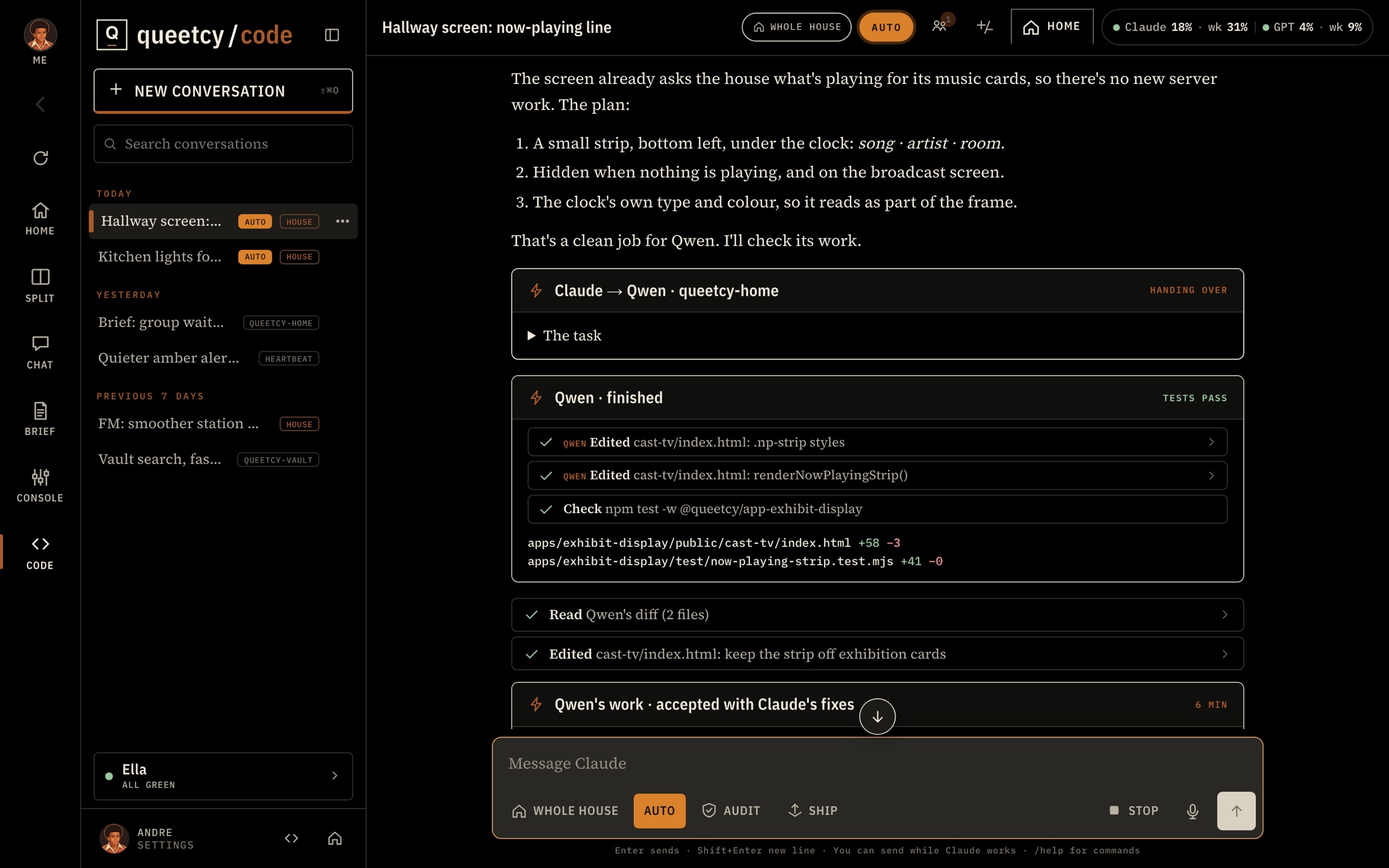
  • Do. The workers build it. Claude handles the delicate parts, and a local AI engineer running at home takes the routine jobs. Background helpers can work on several things at once while you keep talking.

Then a fresh reviewer who has never seen the work checks it. Nothing is published until you press Ship. The local engineer also learns: every correction becomes a rule it reads the next time.

Code: Claude hands a job to the local engineer and checks its work
Split View

Two things at once.

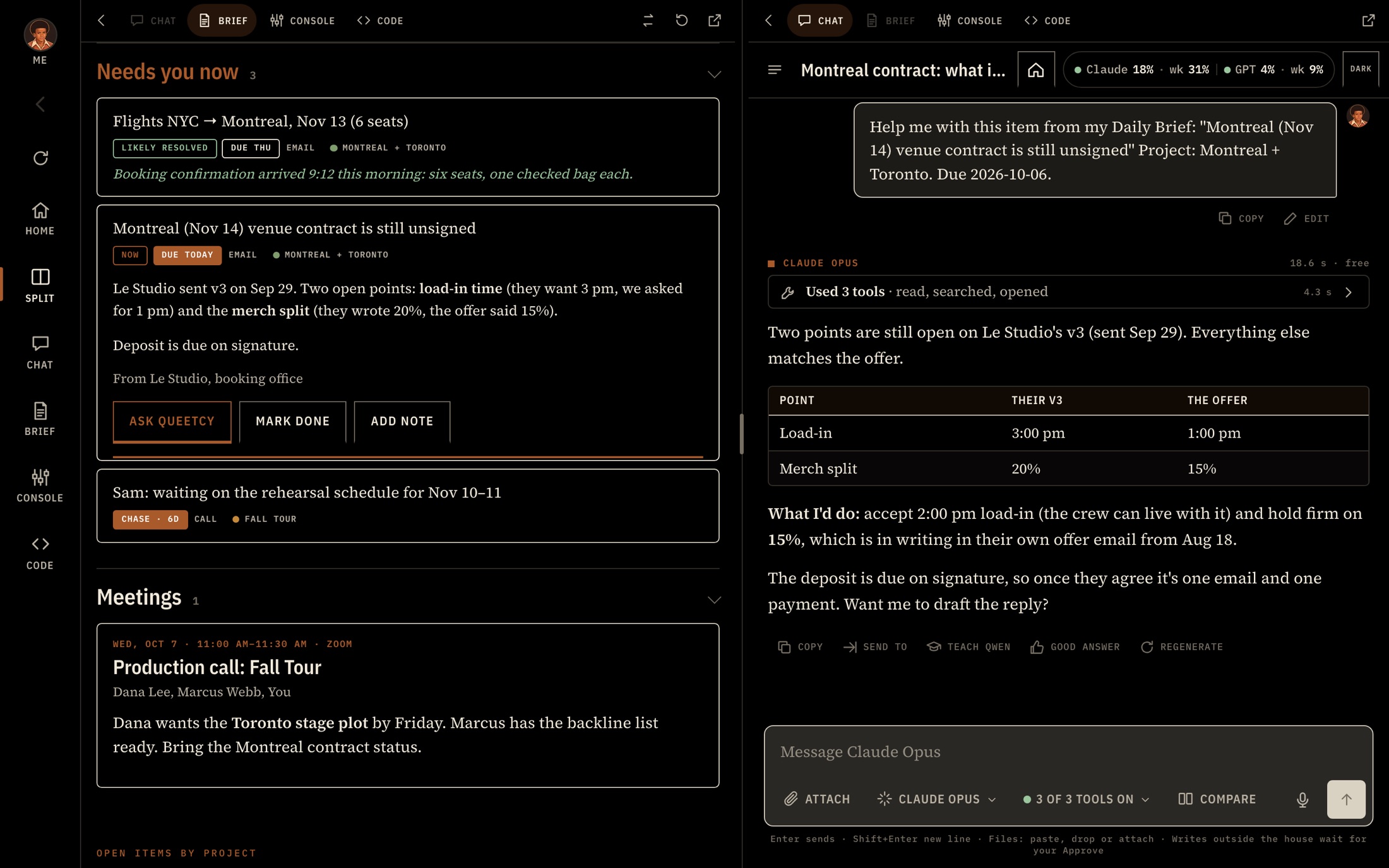
Put any two side by side: the Brief next to Chat, Console next to Code, or the tour calendar next to a client's desk. Each side works on its own, and they work together: tap "Ask Queetcy" on a Brief item and the question lands in the chat beside it.

Split View: the Brief beside Chat
Dashboard

The house, at a glance. Coming soon

  • Self-healing. The local AI is always monitoring the systems. It fixes what it can and diagnoses what it can't, so the problem arrives on Claude's desk ready for instructions.
  • What AI really costs. What you're actually paying, by area and by provider, with subscriptions and pay-by-the-question kept apart, so you know whether that monthly plan is earning its keep.
  • Report cards. Which AI answered better, how often the local engineer's work gets accepted, how often voice gets it right first time. Honest scores, kept over time, so you can tell whether the tailor is getting better.
Dashboard All systems
Music
TVs
Art
Voice
Brief
Chat
Code
Backups
Art: the hallway Frame went to sleep. Woke it and restaged Room 2. No action needed.
Pay per questionSubscriptions
96%Local engineer accepted
ClaudeWins compares this week
91%Voice right first time
Where it works

Everywhere you are.

Your own devices

Native apps for Mac, iPhone, iPad, the new iPhone Duo (every fold and spread of it) and Apple Vision Pro, with Chat, Code and the Brief floating side by side in the room. One sign-in and one look everywhere, plus a web app just in case.

The TV

A custom launcher on Google TV, because Apple TV doesn't play nice with customization.

Out loud

Just ask Queetcy.

Console on iPhoneChat on iPhone
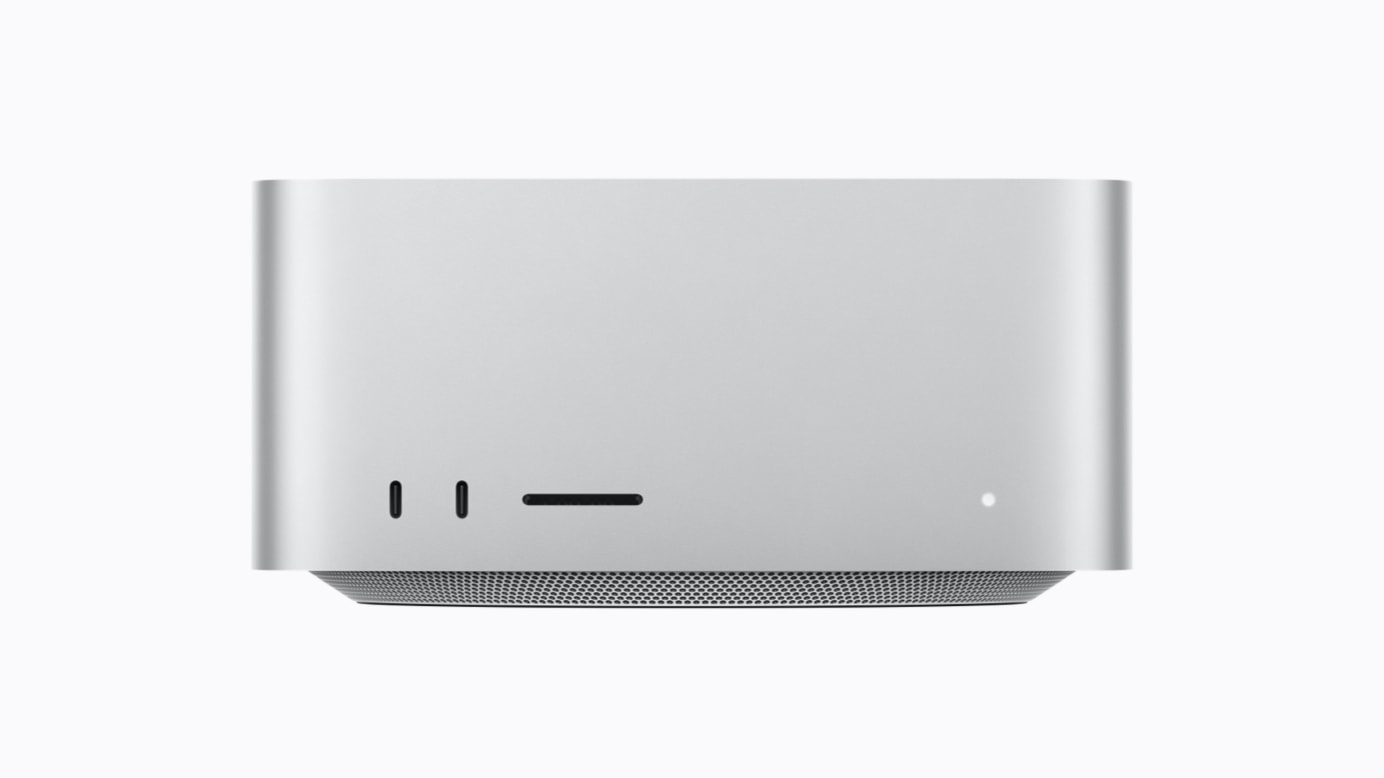
Mac Studio, front
Ella
Mac Studio · M5 Max

The voice and the bandleader. She runs the house, keeps the time and calls the tunes.

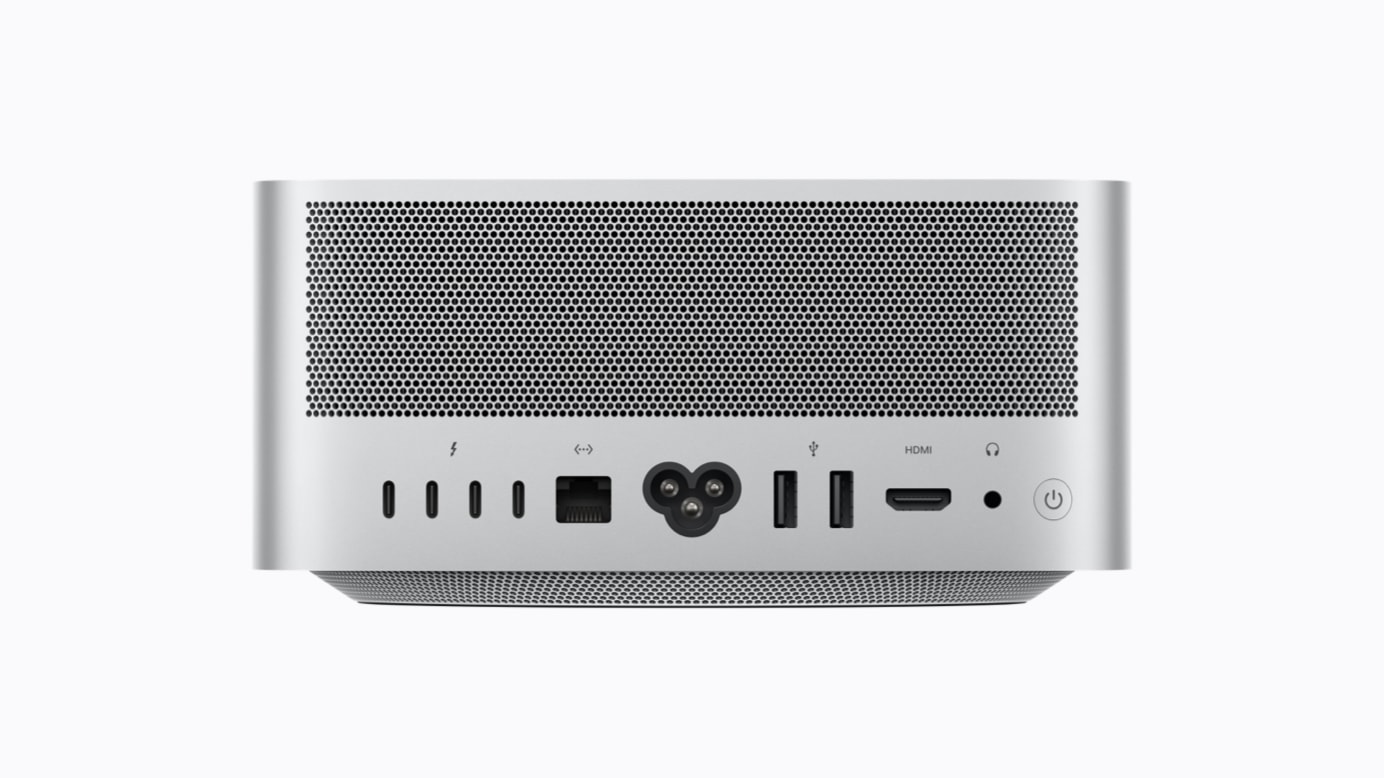
Mac Studio, back
Louis
Mac Studio · M5 Max

In the workshop doing the heavy lifting: the coding, the experiments and the local engineer.

Your data stays home

Most AI moves your life into someone else's database.
Queetcy works the other way around.

It lives in your house.

Your history, memory, music, documents and conversations sit on Ella and Louis, in your own database.

Mirrors, not leaks.

Your mail, calendar and Drive are copied home and kept in sync, so the AI reads the copy in your house instead of going out to fetch them.

It asks before going out.

When a question needs one of the big outside models, that model gets the question, not your filing cabinet. Simple jobs stay with your private AI and never leave.

Nothing leaves unless you want it to.

Sending, inviting, sharing and paying all need your tap. Still no rogue agents.

Who made it
The tailor does the sewing, but somebody has to know what a good suit looks like.

Built by an audiophile gadget geek who isn't a coder or a software engineer, but plays one on TV.

For years he worked with musicians on what he called career architecture: helping them figure out what they wanted to do artistically, then putting a plan in place to turn those aspirations into reality. Queetcy is the same thing. Dream it, design it, do it.

AI writes every line of code. What makes it come out right is knowing what to ask for, and that comes from years in actuarial science, database design and SQL, executive management and consulting.

What's new

Release notes.

Not for sale

Just tailored.

Queetcy is a showcase: one house, made to measure. But if you're wondering what your tailor might make for you, maybe I can help.

Get in touch